Ram Sasisekharan, James R. Myette
The Sweet Science of Glycobiology
Complex carbohydrates, molecules that are particularly important for communication among cells, are coming
under systematic study
Carbohydrates are the often-overlooked third major class of biological polymers. Though they have received much less notice
than nucleic acids or proteins, they are just as essential for life. Complex sugars, or glycans, which are generally bound to
proteins, coat the outsides of cells and fill the spaces between them. Crucial in normal animal development and in preventing
many diseases, glycans appear to act as scaffolds that mediate interactions between proteins. The authors describe the
progress made recently in identifying or "sequencing" polysaccharides, in understanding their functions and in beginning to
exploit them in medicine.
The Sweet Science of Glycobiology
Complex carbohydrates, molecules that are particularly important for communication among cells, are coming
under systematic study
Carbohydrates are the often-overlooked third major class of biological polymers. Though they have received much less notice
than nucleic acids or proteins, they are just as essential for life. Complex sugars, or glycans, which are generally bound to
proteins, coat the outsides of cells and fill the spaces between them. Crucial in normal animal development and in preventing
many diseases, glycans appear to act as scaffolds that mediate interactions between proteins. The authors describe the
progress made recently in identifying or "sequencing" polysaccharides, in understanding their functions and in beginning to
exploit them in medicine.
Mark M. Fuster; Jeffrey D. Esko
The Sweet and Sour of Cancer: Glycans as Novel Therapeutic Targets
Nat Rev Cancer. 2005;5(7):526-542. ©2005 Nature Publishing Group
Posted 07/25/2005
Abstract
A growing body of evidence supports crucial roles for glycans at various pathophysiological steps of tumour progression.
Glycans regulate tumour proliferation, invasion, haematogenous metastasis and angiogenesis, and increased understanding of
these roles sets the stage for developing pharmaceutical agents that target these molecules. Such novel agents might be used
alone or in combination with operative and/or chemoradiation strategies for treating cancer.
To read full text article, you will need to sign in to medscape
The Sweet and Sour of Cancer: Glycans as Novel Therapeutic Targets
Nat Rev Cancer. 2005;5(7):526-542. ©2005 Nature Publishing Group
Posted 07/25/2005
Abstract
A growing body of evidence supports crucial roles for glycans at various pathophysiological steps of tumour progression.
Glycans regulate tumour proliferation, invasion, haematogenous metastasis and angiogenesis, and increased understanding of
these roles sets the stage for developing pharmaceutical agents that target these molecules. Such novel agents might be used
alone or in combination with operative and/or chemoradiation strategies for treating cancer.
To read full text article, you will need to sign in to medscape
Other Links and Resources
| Glycobiology is a new field of science that combines the expertise of both carbohydrate (sugar) biochemistry and molecular biology. Involved is the study of the structure, chemistry, biosynthesis, and biological functions of glycans and their derivatives. |
|

Click this tab


| Glycibiology Section |

Joseph R. Bishop, Manuela Schuksz, Jeffrey D. Esko
Heparan sulphate proteoglycans fine-tune mammalian physiology
Heparan sulphate proteoglycans reside on the plasma membrane of all animal cells studied so far and are a major component of
extracellular matrices. Studies of model organisms and human diseases have demonstrated their importance in development
and normal physiology. A recurrent theme is the electrostatic interaction of the heparan sulphate chains with protein ligands,
which affects metabolism, transport, information transfer, support and regulation in all organ systems. The importance of these
interactions is exemplified by phenotypic studies of mice and humans bearing mutations in the core proteins or the biosynthetic
enzymes responsible for assembling the heparan sulphate chains.
SUMMARY: Heparan sulphate proteoglycans reside on the plasma membrane of all animal cells studied so far and are a major
component of extracellular matrices. Studies of model organisms and human diseases
CONTEXT: hereditary multiple exostoses, an autosomal dominant disease characterized by the formation of cartilage-capped
bony outgrowths (osteochondromas or exostoses) on growth plates throughout the body. Heterozygous mice also develop...
Nature 446, 1030 - 1037 (25 Apr 2007) Insight
Heparan sulphate proteoglycans fine-tune mammalian physiology
Heparan sulphate proteoglycans reside on the plasma membrane of all animal cells studied so far and are a major component of
extracellular matrices. Studies of model organisms and human diseases have demonstrated their importance in development
and normal physiology. A recurrent theme is the electrostatic interaction of the heparan sulphate chains with protein ligands,
which affects metabolism, transport, information transfer, support and regulation in all organ systems. The importance of these
interactions is exemplified by phenotypic studies of mice and humans bearing mutations in the core proteins or the biosynthetic
enzymes responsible for assembling the heparan sulphate chains.
SUMMARY: Heparan sulphate proteoglycans reside on the plasma membrane of all animal cells studied so far and are a major
component of extracellular matrices. Studies of model organisms and human diseases
CONTEXT: hereditary multiple exostoses, an autosomal dominant disease characterized by the formation of cartilage-capped
bony outgrowths (osteochondromas or exostoses) on growth plates throughout the body. Heterozygous mice also develop...
Nature 446, 1030 - 1037 (25 Apr 2007) Insight
|








Heparan Sulfates - Regulators of Cell Functions
Heparan sulfates (HS): are glycans (complex sugars) found on all cell surfaces
which act by binding selectively to a variety of proteins and pathogens and
are critically relevant to many disease processes (eg. , inflammation,
neurodegeneration, angiogenesis, wound healing, cancer, cardiovascular
disordersand infectious diseases). Many of these activities have been detected
using heparin, which is a subclass of the HS family of glycans .
Heparan sulfates (HS): are glycans (complex sugars) found on all cell surfaces
which act by binding selectively to a variety of proteins and pathogens and
are critically relevant to many disease processes (eg. , inflammation,
neurodegeneration, angiogenesis, wound healing, cancer, cardiovascular
disordersand infectious diseases). Many of these activities have been detected
using heparin, which is a subclass of the HS family of glycans .

Heparin and heparan sulphates act by binding to proteins and regulating
their biological activities.
The picture shows the interaction of a small heparin hexasaccharide (6 sugar
units) with the growth factor called basic FGF that controls the growth and
differentiation of many cell types.

The HS family of sugars are composed of long chains of repeating disaccharide
units of uronic acid and glucosamine residues, decorated by variable patterns of
sulphate and carboxyl groups, giving them very strong negative charge.
They are produced in living cells by a complex multi-step enzymatic biosynthetic
process.
Heparin is a highly sulphated and relatively structurally homogenous molecule
compared to cellular heparan sulphates, which have increased sequence
diversity and fulfil many complex biological functions by interacting with
proteins and influencing their biological activities.
units of uronic acid and glucosamine residues, decorated by variable patterns of
sulphate and carboxyl groups, giving them very strong negative charge.
They are produced in living cells by a complex multi-step enzymatic biosynthetic
process.
Heparin is a highly sulphated and relatively structurally homogenous molecule
compared to cellular heparan sulphates, which have increased sequence
diversity and fulfil many complex biological functions by interacting with
proteins and influencing their biological activities.
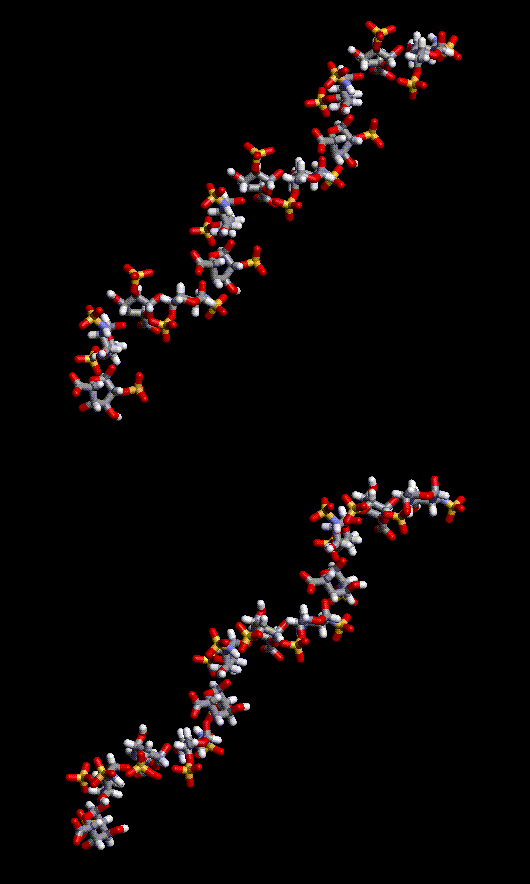
Animated picture shows an extended helical
heparin sequence with sulphate groups
(yellow/red) decorating the backbone (image
courtesy of Dr Barbara Mulloy, National
Institiute of Biological Standards, Herts, UK)
heparin sequence with sulphate groups
(yellow/red) decorating the backbone (image
courtesy of Dr Barbara Mulloy, National
Institiute of Biological Standards, Herts, UK)

HS and heparin are produced on cells by a complex process involving
the sequential action of multiple enzymes which knit together the repeating
disaccharide units (polymerases) and then modify them with exquisitely
complex patterns of sulphate groups (sulfotransferases). The resulting
structural motifs bind to specific proteins and influence their biological
activities.
the sequential action of multiple enzymes which knit together the repeating
disaccharide units (polymerases) and then modify them with exquisitely
complex patterns of sulphate groups (sulfotransferases). The resulting
structural motifs bind to specific proteins and influence their biological
activities.

Heparan sulphate binds proteins
Heparin and heparan sulphates act by binding to proteins and regulating
their biological activities.
The picture shows the interaction of a small heparin hexasaccharide (6 sugar
units) with the growth factor called basic FGF that controls the growth and
differentiation of many cell types.
Heparin and heparan sulphates act by binding to proteins and regulating
their biological activities.
The picture shows the interaction of a small heparin hexasaccharide (6 sugar
units) with the growth factor called basic FGF that controls the growth and
differentiation of many cell types.

heparan sulfate proteoglycans (HSPGs), are ubiquitous glycoproteins present at the cell surface and in the extracellular matrix,
and have their roles in neuron migration, process outgrowth and guidance and in synapse formation. HSPGs contain a protein
core substituted with heparan sulphate (HS) polysaccharide chains, which encode complex sugar sequences with variant
sulfation patterns that confer biological functions as protein regulators. HS/HSPGs play essential roles in controlling cell
differentiation, tissue morphogenesis and homeostasis. In the nervous system, HS and HSPGs have been implicated in neuron
migration, axon guidance, synapse formation and maturation and control of physiological responses such as feeding, learning
and memory.
and have their roles in neuron migration, process outgrowth and guidance and in synapse formation. HSPGs contain a protein
core substituted with heparan sulphate (HS) polysaccharide chains, which encode complex sugar sequences with variant
sulfation patterns that confer biological functions as protein regulators. HS/HSPGs play essential roles in controlling cell
differentiation, tissue morphogenesis and homeostasis. In the nervous system, HS and HSPGs have been implicated in neuron
migration, axon guidance, synapse formation and maturation and control of physiological responses such as feeding, learning
and memory.
HS/heparin structure
HS and heparin are long, linear chains of sugars, composed of repeating
disaccharide units made up of alternating uronic acid (glucuronic or iduronic
acid) and glucosamine residues. The backbone structure is then decorated
with complex patterns of sulphate groups at various positions.
HS and heparin are long, linear chains of sugars, composed of repeating
disaccharide units made up of alternating uronic acid (glucuronic or iduronic
acid) and glucosamine residues. The backbone structure is then decorated
with complex patterns of sulphate groups at various positions.

| To Read about the Glycobiology Research being done in Multiple Hereditary Exostoses/Osteochondroma Click Here |
| ||||||||||||||||||||||||||||||||||||||||||||||||||||||||||||||||||||||||||||||||||||||||||||||||||||||||||||||||||||||||||||||||||||||||||||||||||||||||||||||||||||||||||||||||||||||||||||


| ||||||||||
The MHE Research Foundation, we comply with the HONcode standard for health trust worthy information: By the Health On the Net Foundation.
Click here to verify.# HON Conduct 282463 and is the patient support link on the US Government Genetics Home Reference (http://ghr.nlm.nih.gov)
website, also linked for Patient Information on The Diseases Database a cross-referenced index of human disease, as well as the
Intute: health & life sciences a free online service providing access to the very best Web resources for education and research located in the UK
Click here to verify.# HON Conduct 282463 and is the patient support link on the US Government Genetics Home Reference (http://ghr.nlm.nih.gov)
website, also linked for Patient Information on The Diseases Database a cross-referenced index of human disease, as well as the
Intute: health & life sciences a free online service providing access to the very best Web resources for education and research located in the UK
The MHE Research Foundation is proud to be working with the EuroBoNeT consortium, a European Commission granted Network of Excellence for
studying the pathology and genetics of bone tumors.
studying the pathology and genetics of bone tumors.
| This website is regularly reviewed by members of the Scientific and Medical Advisory Board of the MHE Research Foundation. All online submission forms use (SSL AES 256 bit encryption (High); RSA 1024 bit exchange) Protocol with Privacy protection. Our goal is to make this website as safe and user friendly as possible. |


| The MHE Research Foundation is a participating member organization of the United States Bone and Joint Decade, (USBJD) & the USBJD Rare Bone Disease Patient Network |
| Written consent must be obtained to attach web pages or the files attached to this website, please email the webmaster. Email the webmaster: webmaster@mheresearchfoundation.org Materials on this website are protected by copyright Copyright © 2009 The MHE Research Foundation Disclaimer: While many find the information useful, it is in no way a substitute for professional medical care. The information provided here is for educational and informational purposes only. This website does not engage in the practice of medicine. In all cases we recommend that you consult your own physician regarding any course of treatment or medicine. This web page was updated last on 12/16/09, 4:0O pm Eastern time |


The MHE Research Foundation is proud to be an affiliate of the Society For Glycobiology


